Argenta
DXP standardisation, vendor consolidation, and unlocking cloud-exclusive capabilities
Migrating Argenta's web platform to AEM as a Cloud Service, reducing vendor complexity, closing a DORA compliance gap & unlocking a cloud-native roadmap.

Project metadata



The real problem wasn't uptime
Argenta's public web platform had performed well for over six years: 99.98% availability, no intrusions, no service-disrupting attacks. Uptime was not the issue.
The challenge was the operating model behind it.
Since 2018, the Argenta web platform was running on Adobe Experience Manager in an AWS-based environment, hosted by a third party, with Argenta managing the coordination between Adobe (software vendor), the hosting provider (infrastructure), and AmeXio (application-specific support). Three separate accountability lines for one platform. Every change required cross-party orchestration and every incident needed triage before it could even be assigned.
For an IT organisation working to simplify its supplier landscape, this arrangement had become unsustainable.
Three compounding factors made the case for change.
1) Vendor fragmentation and accountability gaps
No single party owned the full stack. Incident resolution required all three suppliers to align before action could be taken. This was not just an inconvenience, but an operational risk. Under the EU's Digital Operational Resilience Act (DORA), it is also a compliance issue.
2) A codebase drifting from vendor-supported standards and best-practices
Long-lived platforms typically accumulate customisation: legacy authoring components, environment-specific configurations, bespoke workflows, integrations co-hosted on the application servers, etc. Each custom element complicated onboarding for new developers. Moreover, every upgrade was turned into a compatibility exercise. Over time, technical debt is a cost that compound, severely impacting maintenance cost and time-to-market.
3) No access to Adobe's innovation roadmap
Edge Delivery Services, the Universal Editor, AI-assisted search, document-based authoring, Experience Agents: Adobe's product investment is clearly concentrated in AEMaaCS. Remaining on-premises meant staying permanently outside that investment envelope.
The decision: migrate to AEMaaCS, retire the legacy hosting layer, and consolidate onto a single Adobe-managed platform with a single partner to provide end-to-end support across the full stack.
Why this mattered for DORA
The EU's Digital Operational Resilience Act (DORA) entered full enforcement in January 2025. For financial institutions, it establishes binding obligations across ICT risk management, third-party concentration risk, and contractual requirements for every technology provider in scope.
Each provider in scope means a set of contracts to maintain, audit rights to negotiate, exit strategies to document, and incident notification procedures to test. A three-party model (platform vendor, hosting provider, implementation partner) means three times the compliance overhead, and a governance structure where accountability at the boundaries between vendors is difficult to make legible to auditors.
Consolidating to a single platform operator (Adobe) and a single application partner (AmeXio) directly simplified this picture. The division of responsibilities is clear, the audit surface is smaller and the accountability chain (who is responsible for what, and how incidents are escalated) can be documented unambiguously.
Cost control for a cloud-based SaaS solution
One of the first things AmeXio addressed as part of the project, before any code moved, was supporting Argenta with assessing the required number of Content Requests for their use case. Content Requests are Adobe's usage-based metric for AEMaaCS. They cover more than merely pageviews: assets, content fragments, requests to JSON endpoints, and any published content returned to the end user all count toward the license threshold. In our experience across multiple AEMaaCS implementations, estimates derived from web analytics are an unreliable metric for this use case, usually undercounting actual volume by a significant margin.
Rather than estimate or extrapolate these numbers, AmeXio obtained access to Argenta's production CDN access logs and assessed actual Content Request volume against Adobe's published counting rules. The output was a precise, traffic-grounded baseline Argenta could take into licensing negotiations, turning a common post-go-live financial risk into an upfront, contractually defensible number.
Four months from kick-off to go-live
The migration project ran from December 2025 to March 2026. Four months for a regulated financial institution's primary customer-facing platform, covering code modernisation, content migration, integration streamlining, governance, and user acceptance testing, is a fast delivery. It was possible because of two things:
- AmeXio's existing depth of knowledge of Argenta's platform and internal processes
- A delivery methodology built around business continuity
We set out with 1 core principle in mind from day one: the existing platform should be kept running normally throughout the transition process. Business/marketing should experience the migration as a quiet handover, not a disruptive event.
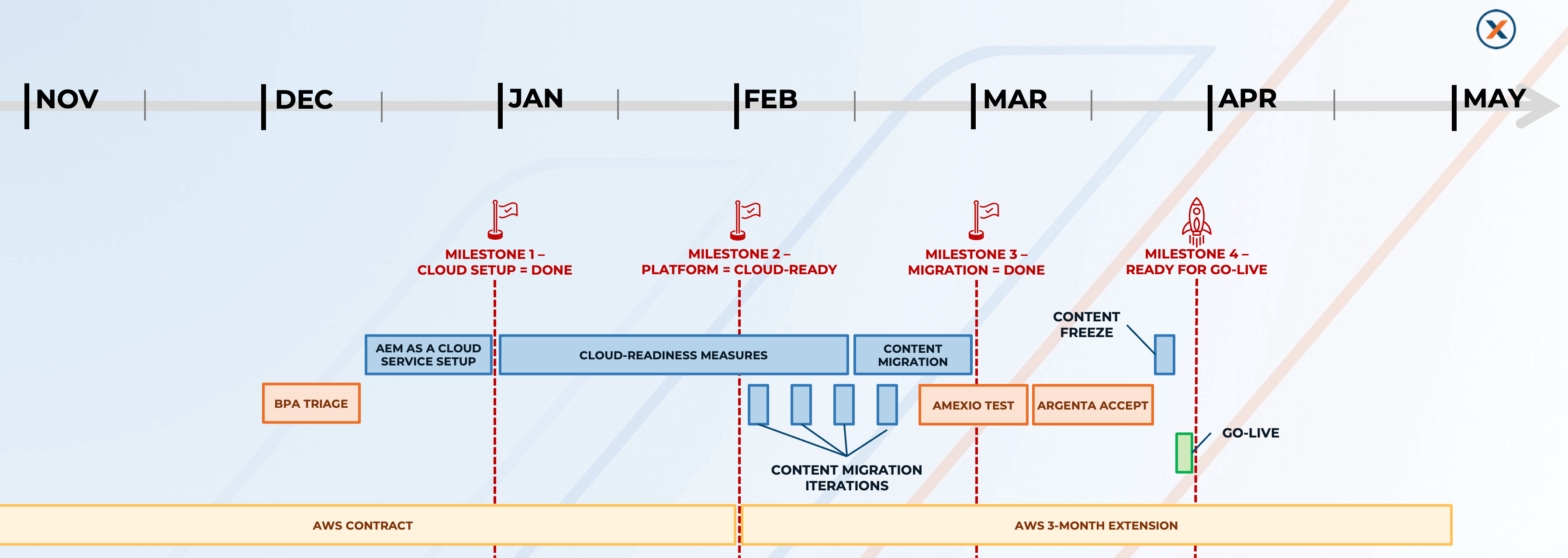
Parallel operation. The source platform stayed live and authors continued working on it for the entire migration window. The target environment was built alongside it. At no point did Argenta's business depend on an environment that had not yet been proven.
Dual-contract planning. Large migrations do not always finish precisely when the original contract ends. Therefore, AmeXio negotiated a short-term extension of the existing hosting arrangement scoped specifically to the migration window, preserving Argenta's flexibility should the timeline shifted.
Multiple content migration rehearsals. Content was migrated through Adobe's Content Transfer Tool using multiple cycles: iterative runs during implementation to keep environments synchronised with production, and a final delta transfer following a planned content freeze. By the cutover date, the process was a rehearsed routine with minimal risk for failure or hick-ups.
Custom validation tooling. AmeXio built a comparison tool running side-by-side HTML and visual screenshot diffs between source and target environments. This catches the class of issues (rendering differences, page structure changes, etc.) that functional test plans typically miss between platform versions.
Governance through existing channels. Architecture decisions, change request approvals, and security reviews flowed through Argenta's standard governance boards from the start of the project. AmeXio's existing familiarity with those processes meant no discovery phase, no additional onboarding, and no period of further alignment before the team could start working on the transition.
Close collaboration with Adobe. Throughout the project, AmeXio and Argenta worked in close alignment with Adobe's customer onboarding and customer success teams. Biweekly status calls kept all parties informed of progress, surfaced impediments early, and ensured that platform decisions were made with direct input from Adobe. This level of involvement requires a trusted partner relationship, meaning having Adobe as an active participant in the migration rather than a vendor following on the sideline.
The technical execution followed Adobe's recommended migration framework (Readiness, Implementation, Go-Live). During Readiness, Adobe's Best Practices Analyzer (BPA), an automated audit tool that scans an existing AEM implementation for cloud compatibility issues, surfaced over 3000 findings across Argenta's platform. The first step was triage: separating findings that materially affect cloud compatibility from those that consume budget without changing the outcome. It was also about detecting certain edge cases a generic assessment would've missed. During Implementation, AI-assisted refactoring using Claude Code accelerated the repetitive migration work: bulk pattern conversions, configuration rewrites, dispatcher updates, etc. Architecture decisions and code review remained with senior engineers.
For areas where lift-and-shift was not the right answer (search infrastructure, enterprise data integrations, CDN error handling, Spring Boot applications that sat alongside the AEM stack), each was scoped as a discrete decision with clear solutions.
From the start, there was a high level of transparency about the expected business impact, which gave us confidence throughout the journey.
Communication was clear, consistent, and proactive at every stage of the migration. The transition itself was smooth and never disrupted our day-to-day work as a marketing team, concluded with a grounded coaching in the authoring experience. Whenever questions arose, we received prompt and well-founded support, which made a real difference in keeping momentum.
Overall, the project and the collaboration with Amexio allowed us to stay focused on delivering value, while trusting that the platform evolution was in good hands.
What changed operationally
Vendor accountability: Adobe operates the AEM platform, while AmeXio operates and supports the application under agreed SLA. The legacy hosting layer is retired, resulting in a single escalation path and a clear functional roadmap to align with.
Security patching: Adobe delivers platform security updates, bug fixes and feature updates continuously as part of the managed SaaS. The challenges associated with coordinating manual updates across custom infrastructure was eliminated.
Delivery pipeline: Adobe's Cloud Manager replaces a tailored CI/CD chain that had to be maintained separately. For Argenta, we now run one single pipeline, with Adobe's release cadence applied automatically.
Identity and access management: User provisioning and access control was moved onto Adobe's managed identity service, removing a separate operational dependency.
Test coverage: The codebase is covered by a much broader set of automated tests, reducing the risk of quality regression.
Codebase: Configuration follows the patterns recommended by Adobe. Future Adobe releases now integrate cleanly rather than requiring compatibility work. Future team members can onboard more quickly and have less reliance on institutional knowledge.
The outcome
The migration completed according to plan, within the four-month window we had foreseen.
User acceptance testing produced remarkably few findings. At one point, the Argenta testing team questioned whether they were testing thorough enough, because there was simply not much to find.
Engineering capacity previously absorbed by hosting coordination, manual maintenance cycles, and cross-vendor management is now available for product development and customer-facing work.
The migration to AEM as a Cloud Service marks an important step for Argenta in simplifying our IT landscape and strengthening our digital capabilities. Thanks to the close and transparent collaboration with AmeXio, this journey progressed very smoothly.
Their in-depth knowledge of both the existing platform and the new cloud environment enabled fast and well-informed decision-making, with minimal impact on our operations. What we particularly value is their proactive approach: AmeXio continuously challenged us, provided clear feedback, and identified improvement opportunities before they became risks.
This project is a strong example of how effective collaboration and shared ownership result in efficient delivery and a future-ready platform.
Core capabilities this project unlocks
Edge Delivery Services: sub-second delivery for performance-sensitive marketing pages, decoupled from the publish tier and adoptable selectively rather than as part of a re-platforming exercise.
Universal Editor and document-based authoring: for content contributors and subject-matter experts who would rather work in a browser or familiar office tools than in a CMS interface.
Headless content delivery: for omnichannel use cases as Argenta's digital footprint further extends beyond their public website.
AI-assisted search: a future evolution of the current search experience, available without another platform migration.
AEM Agents: ability to accelerate content creation and automatically orchestrate changes using the Brand Experience Agent, Content Advisor Agent and Governance Agent.
Thanks to the close collaboration between Argenta, AmeXio and Adobe, the move to Adobe Experience Manager as a Cloud Service is more than a technology upgrade: it lays the foundation for secure, personalized and future-ready customer experiences. AmeXio's deep understanding of Argenta's environment, paired with a pragmatic, hands-on approach, enabled fast and well-grounded decisions throughout the project. Together, we're shaping the next generation of digital banking, with the customer always at the center.
AmeXio and Adobe will continue working with Argenta to assess how these capabilities can improve the experience for both customers and the marketing team. First area under exploration includes Adobe LLM Optimizer, to enhance search and content discovery for AI search engines (GEO).
The cloud migration does not mark the end of the journey: it marks the point from which the real capability work can begin and additional use cases can be explored and implemented.